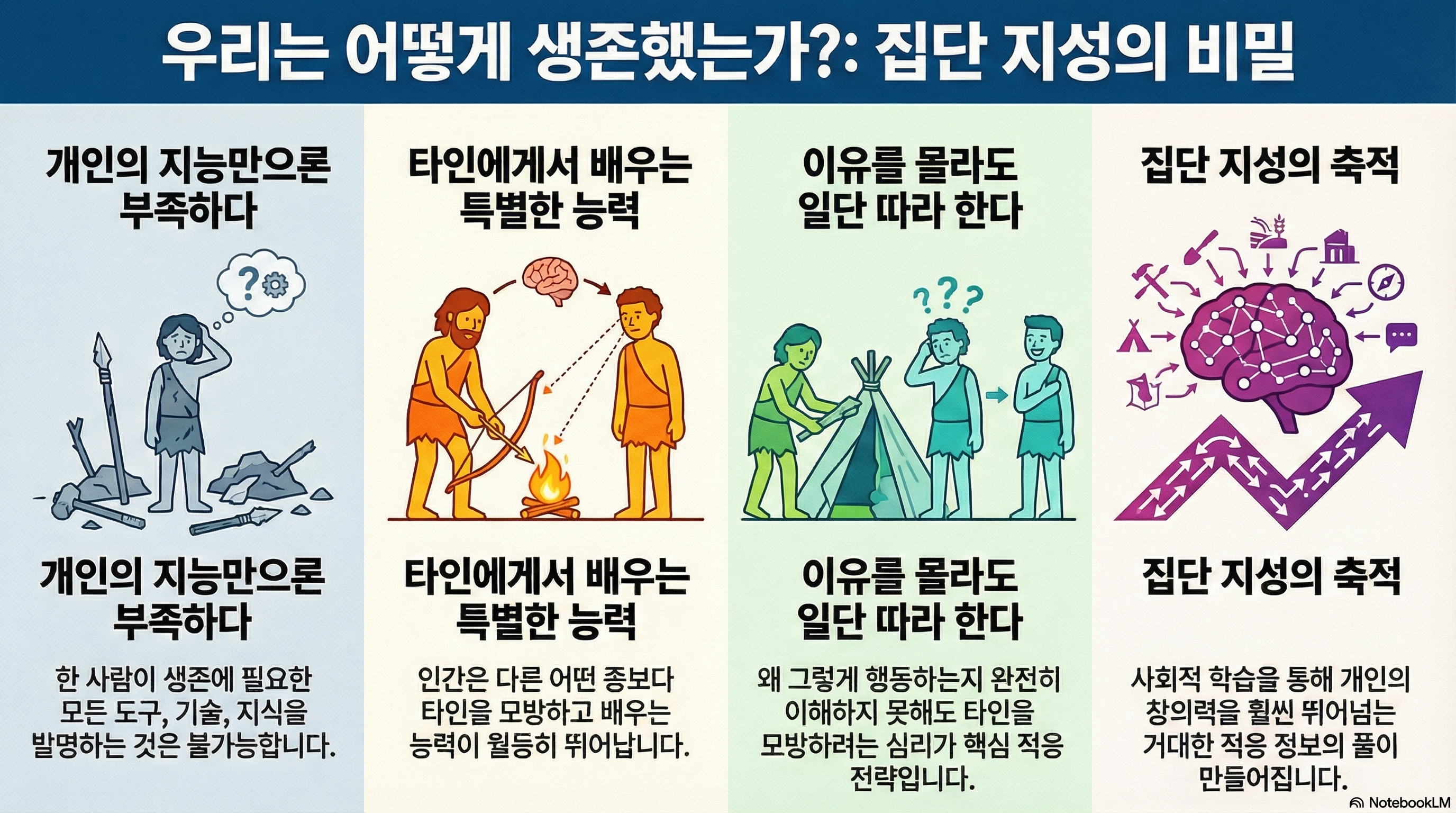
[2026학년도 수능영어 29번] We are exceptionally smart, and this helps us adapt to a wide range of environments. But we are not nearly smart enough as individuals to solve the adaptive problems that confronted modern humans as they spread across the globe. The package of tools, foraging techniques, ecological knowledge, and social arrangements used by any group of foragers is far too complex for any individual to create. We are able to learn all the things we need to know in each of the many different environments in which we live only because we acquire information from others. We are much better at learning from others than other species are, and we are motivated to learn from others even when we do not understand why our models are doing what they are doing. This psychology allows human populations to accumulate pools of adaptive information that greatly exceed the inventive capacities of individuals.
📌 핵심 주제
인간은 개별적인 지능의 한계를 넘어 타인으로부터 학습하고 적응 정보를 축적하는 능력을 통해 복잡한 환경에 성공적으로 적응한다.
🔄 논리 구조
인간의 영리함과 적응 능력 제시(1)-> 개별 인간 지능의 한계 지적(2-3) -> 타인으로부터의 학습을 통한 적응 능력 설명(4) -> 인간의 특화된 사회적 학습 능력 강조(5) -> 사회적 학습을 통한 적응 정보 축적의 이점 요약(6)
📝 문장별 상세 분석
1We are exceptionally smart, and this helps us adapt to a wide range of environments.
2But we are not nearly smart enough as individuals to solve the adaptive problems that confronted modern humans as they spread across the globe.
하지만 우리는 개별적으로는 현대 인간이 전 세계로 퍼져나가면서 직면했던 적응 문제들을 해결할 만큼 충분히 영리하지 않다.
💡 핵심 의미:개별 인간은 전 세계로 퍼져나가며 직면한 적응 문제들을 해결할 만큼 충분히 영리하지 못했다.
🔍 구문 분석:
not nearly smart enough as individuals to solve→ ‘거의 ~하지 못하다’를 의미하는 not nearly와 ‘~할 만큼 충분히 ~하지 않다’를 나타내는 ‘not enough to-V’ 구문이 결합되어 ‘개인으로서 ~를 해결할 만큼 충분히 영리하지 않다’라는 의미다.
that confronted modern humans→ 관계대명사 that이 이끄는 절로, 선행사 ‘the adaptive problems’를 수식한다. ‘현대 인간에게 닥쳤던 적응 문제들’을 의미한다.
as they spread across the globe→ ‘~할 때’를 의미하는 접속사 as가 이끄는 부사절이다. ‘they’는 ‘modern humans’를 지칭한다.
3The package of tools, foraging techniques, ecological knowledge, and social arrangements used by any group of foragers is far too complex for any individual to create.
어떤 수렵 채집민 집단이 사용하는 도구, 채집 기술, 생태 지식, 그리고 사회적 배열의 총체는 너무 복잡해서 어떤 개인이 만들 수 없다.
💡 핵심 의미:수렵 채집민이 사용하는 복잡한 도구, 기술, 지식, 사회적 체계는 개인이 만들 수 없다.
🔍 구문 분석:
The package... used by any group of foragers→ ‘package’가 문장의 주어다. ‘used by any group of foragers’는 과거분사구로 주어 ‘package’를 수식한다. ‘어떤 수렵 채집민 집단이 사용하는 도구 등의 총체’를 의미한다.
far too complex for any individual to create→ ‘너무 ~해서 ~할 수 없다’를 의미하는 ‘too ~ for... to-V’ 구문이다. ‘far’는 ‘too complex’를 강조한다. ‘어떤 개인이 만들기에는 너무 복잡하다’라는 의미다.
4We are able to learn all the things we need to know in each of the many different environments in which we live only because we acquire information from others.
우리는 오직 타인에게서 정보를 얻기 때문에 우리가 살아가는 수많은 다양한 환경 각각에서 알아야 할 모든 것을 배울 수 있다.
💡 핵심 의미:우리는 타인에게서 정보를 얻기에 다양한 환경에서 필요한 것을 학습할 수 있다.
🔍 구문 분석:
all the things we need to know→ ‘things’와 ‘we’ 사이에 목적격 관계대명사(that 또는 which)가 생략되어 ‘우리가 알아야 할 모든 것’을 의미한다.
in which we live→ 관계대명사 ‘which’가 이끄는 관계절로, 선행사 ‘environments’를 수식한다. ‘우리가 살아가는 환경’을 의미하며, ‘where we live’로 바꿔 쓸 수 있다.
5We are much better at learning from others than other species are, and we are motivated to learn from others even when we do not understand why our models are doing what they are doing.
우리는 다른 종보다 타인에게서 배우는 것을 훨씬 더 잘하고, 심지어 우리의 본보기가 왜 그들이 하고 있는 것을 하는지 이해하지 못할 때에도 타인에게서 배우려는 동기를 부여받는다.
💡 핵심 의미:인간은 다른 종보다 타인에게서 배우는 데 능하며, 타인의 행동 이유를 몰라도 배운다.
🔍 구문 분석:
much better at learning from others than other species are→ ‘~보다 훨씬 더 잘하다’를 의미하는 비교급 표현이다. ‘are’ 뒤에는 ‘good at learning from others’가 생략되어 있다.
motivated to learn→ ‘~할 동기를 부여받다’라는 의미로, 수동태 형태로 사용되었다.
why our models are doing what they are doing→ ‘why’와 ‘what’이 이끄는 두 개의 의문사절이 연결되어 ‘우리의 본보기가 왜 그들이 하고 있는 것을 하는지’를 의미한다. ‘they’는 ‘our models’를 지칭한다.
6This psychology allows human populations to accumulate pools of adaptive information that greatly exceed the inventive capacities of individuals.
이러한 심리는 인류 집단이 개인의 발명 능력을 훨씬 뛰어넘는 적응 정보 풀을 축적하도록 해준다.
💡 핵심 의미:이러한 심리가 인류 집단이 개인의 발명 능력을 초월하는 적응 정보 축적을 가능하게 한다.
🔍 구문 분석:
This psychology→ 앞 문장(5번 문장)에서 언급된 ‘다른 종보다 타인에게서 배우는 것을 훨씬 더 잘하고, 그 이유를 이해하지 못할 때에도 배우려는 동기를 부여받는 인간의 특성’을 지칭한다.
allows human populations to accumulate→ ‘A가 B하도록 허락하다/가능하게 하다’라는 의미의 ‘allow A to B’ 구문이다.
that greatly exceed the inventive capacities of individuals→ 관계대명사 ‘that’이 이끄는 관계절로, 선행사 ‘pools of adaptive information’을 수식한다. ‘개인의 발명 능력을 훨씬 뛰어넘는 적응 정보 풀’을 의미한다.


댓글