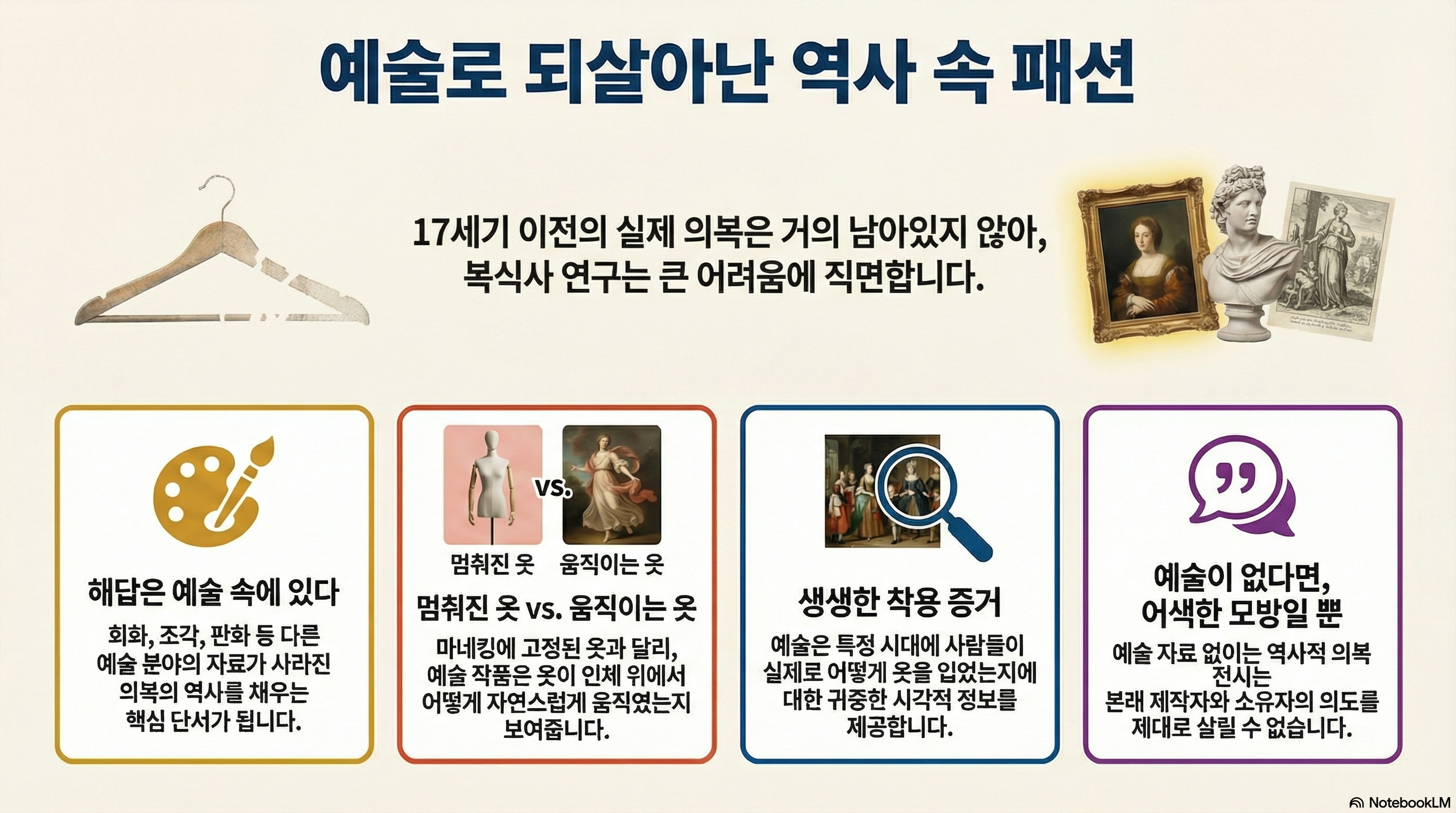
[2026학년도 수능영어 41번] There is an obvious problem with the history of dress in all of its displays and that is, although textiles survive from early periods and cultures of recorded history, actual garments do not provide an uninterrupted flow of evidence across the same long time-span. Therefore, to give the study of dress equal significance to other areas such as architecture, painting, prints, drawings and sculpture, it was inevitable that these other areas would provide much of the source material. The history of surviving dress really only starts in the 17th century, and like all artefacts described as fine or decorative art, is a highly visual subject. However, unlike most of the categories of collection and study that make up those areas, it is fluid rather than static. Garments should be seen in movement on a human body, not frozen on a display figure. This is one of the many difficulties when curating collections of costume and also why some modern writers find costume collections physically and intellectually lifeless. Fortunately, in the period after 1660, when more items of dress survive to enrich our understanding of the history of the subject, there are also many painted, printed, photographed and filmed sources of evidence of people in clothing, caught in movement. Often a variety of different types of illustrative examples will provide evidence about how a garment was worn within the period in which it was made. Without the information contained in art in all of its forms, from drawing to sculpture, it is likely that displays of historic dress would be awkward imitations of the intentions of their original makers and owners.
📌 핵심 주제
실제 의복 유물의 부족과 유동적인 특성으로 인한 의복 역사 연구의 어려움과, 이를 보완하는 미술 작품 속 시각 자료의 중요성이다.
🔄 논리 구조
문제 제기(1) -> 문제 해결을 위한 초기 대응(2) -> 의복 역사의 시각적/유동적 특성 및 어려움 제시(3-6) -> 1660년 이후 해결책(미술 자료)의 풍부화(7-8) -> 미술 자료의 결정적 중요성 강조(9).
📝 문장별 상세 분석
1There is an obvious problem with the history of dress in all of its displays and that is, although textiles survive from early periods and cultures of recorded history, actual garments do not provide an uninterrupted flow of evidence across the same long time-span.
의복의 역사에는 모든 전시에서 명백한 문제가 있는데, 그것은 기록된 역사의 초기 시기와 문화에서 직물은 살아남지만 실제 의복은 같은 긴 시간 동안 끊임없는 증거의 흐름을 제공하지 못한다는 것이다.
💡 핵심 의미:의복 역사 연구는 직물은 존재해도 실제 의복 유물이 부족하다는 명백한 문제를 지닌다.
🔍 구문 분석:
There is an obvious problem with the history of dress in all of its displays and that is→ '~이 있다'는 의미의 'There is' 구문으로 문장을 시작하며, 'that'은 앞서 언급된 'an obvious problem'을 지칭한다.
although textiles survive from early periods and cultures of recorded history, actual garments do not provide an uninterrupted flow of evidence across the same long time-span→ 'although'가 이끄는 양보 부사절과 주절이 대조를 이루며, 의복 유물의 단절된 흐름을 설명한다.
2Therefore, to give the study of dress equal significance to other areas such as architecture, painting, prints, drawings and sculpture, it was inevitable that these other areas would provide much of the source material.
그러므로, 건축, 회화, 판화, 드로잉, 조각과 같은 다른 분야와 의복 연구에 동등한 중요성을 부여하기 위해서는 이러한 다른 분야들이 많은 자료를 제공하는 것이 불가피했다.
💡 핵심 의미:의복 연구가 다른 예술 분야와 동등한 중요성을 얻기 위해선 다른 예술 분야의 자료 활용이 필수적이었다.
🔍 구문 분석:
to give the study of dress equal significance to other areas→ 'to 부정사'의 부사적 용법으로 '목적'을 나타내며, 'give A equal significance to B'는 'A에게 B와 동등한 중요성을 부여하다'는 의미다.
it was inevitable that these other areas would provide much of the source material→ 'it ~ that ~' 가주어-진주어 구문으로, 'inevitable(불가피한)'은 '~하는 것이 불가피하다'는 의미를 형성한다.
3The history of surviving dress really only starts in the 17th century, and like all artefacts described as fine or decorative art, is a highly visual subject.
현존하는 의복의 역사는 실제로 17세기에 비로소 시작되며, 회화나 장식 예술로 묘사되는 모든 인공물처럼, 매우 시각적인 주제다.
💡 핵심 의미:현존하는 의복의 역사는 17세기에 시작되며, 다른 예술품과 마찬가지로 시각적인 특성을 가진다.
🔍 구문 분석:
like all artefacts described as fine or decorative art→ 'like ~'는 '~처럼'이라는 의미로 비유를 나타내며, 'described as fine or decorative art'는 'artefacts'를 수식하는 과거분사구다.
5Garments should be seen in movement on a human body, not frozen on a display figure.
의복은 전시 모형에 고정된 채가 아니라 인체 위에서 움직이는 상태로 보아야 한다.
💡 핵심 의미:의복은 전시된 상태가 아닌 인체 위에서 움직이는 상태로 관찰되어야 한다.
🔍 구문 분석:
should be seen in movement on a human body, not frozen on a display figure→ 'should be + 과거분사' 형태의 수동태 구문으로, 'not frozen'은 'not (be) frozen'으로 'in movement'와 대조되는 상태를 병렬적으로 나타낸다.
📘 어휘:garments(의복), movement(움직임), human body(인체), frozen(고정된, 얼어붙은), display figure(전시 모형)
6This is one of the many difficulties when curating collections of costume and also why some modern writers find costume collections physically and intellectually lifeless.
이것은 의상 컬렉션을 큐레이션할 때의 많은 어려움 중 하나이며, 일부 현대 작가들이 의상 컬렉션을 물리적으로나 지적으로 생명력이 없다고 여기는 이유이기도 하다.
💡 핵심 의미:의복의 유동성은 의상 컬렉션 큐레이션의 어려움이자, 일부 작가들이 의상 컬렉션을 생명 없다고 여기는 이유다.
🔍 구문 분석:
This is one of the many difficulties→ 'This'는 앞 문장의 내용(의복이 움직이는 상태로 보여져야 한다는 것)을 지칭하며, 'one of the 복수명사'는 '~중 하나'라는 의미다.
why some modern writers find costume collections physically and intellectually lifeless→ 'why'는 이유를 나타내는 관계 부사절을 이끌며, 'find + 목적어 + 목적보어' 구문으로 '목적어를 목적보어하다고 여기다'는 의미다.
7Fortunately, in the period after 1660, when more items of dress survive to enrich our understanding of the history of the subject, there are also many painted, printed, photographed and filmed sources of evidence of people in clothing, caught in movement.
다행히도, 1660년 이후의 시기에는 더 많은 의복 품목이 남아있어 이 주제의 역사에 대한 우리의 이해를 풍부하게 해주며, 동시에 옷을 입고 움직이는 사람들의 모습을 담은 많은 회화, 판화, 사진, 영상 자료들이 증거로 존재한다.
💡 핵심 의미:1660년 이후에는 의복 유물이 풍부해졌을 뿐만 아니라, 옷을 입고 움직이는 사람들을 담은 다양한 시각 자료도 많다.
🔍 구문 분석:
when more items of dress survive to enrich our understanding of the history of the subject→ 'when'은 관계부사로 'the period after 1660'을 수식하며, 'to enrich'는 목적을 나타내는 'to 부정사' 부사적 용법이다.
there are also many painted, printed, photographed and filmed sources of evidence→ 'There are' 구문으로, 여러 과거분사들이 병렬적으로 'sources'를 수식하며 증거의 원천을 나타낸다.
caught in movement→ 'people in clothing'을 수식하는 과거분사구로, '(who are) caught in movement'의 의미다.
8Often a variety of different types of illustrative examples will provide evidence about how a garment was worn within the period in which it was made.
종종 다양한 종류의 설명적인 예시들은 의복이 만들어진 시기에 어떻게 착용되었는지에 대한 증거를 제공할 것이다.
💡 핵심 의미:다양한 시각 자료는 특정 시대에 의복이 어떻게 입혀졌는지에 대한 증거를 제공한다.
🔍 구문 분석:
how a garment was worn→ 'about' 전치사의 목적어로 사용된 간접의문문으로, 'how + 주어 + 동사' 어순을 따른다.
in which it was made→ 'the period'를 수식하는 관계대명사절로, 'in which'는 관계부사 'when'으로 대체될 수 있다.
9Without the information contained in art in all of its forms, from drawing to sculpture, it is likely that displays of historic dress would be awkward imitations of the intentions of their original makers and owners.
드로잉부터 조각에 이르기까지 모든 형태의 예술 작품에 담긴 정보가 없다면, 역사적인 의복 전시는 원래 제작자와 소유자의 의도를 어색하게 모방한 것이 될 가능성이 높다.
💡 핵심 의미:미술 작품에 담긴 정보 없이는 역사적 의복 전시는 원래의 의도를 벗어난 어색한 모방이 될 것이다.
🔍 구문 분석:
Without the information contained in art in all of its forms, from drawing to sculpture→ 'Without ~' 구문이 가정법 과거 조건절의 의미를 지니며, 'contained in art'는 'information'을 수식하는 과거분사구다.
it is likely that displays of historic dress would be awkward imitations→ 'it is likely that ~'은 '~일 가능성이 높다'는 의미이며, 주절은 가정법 과거의 형태('would be')를 사용하여 가정된 상황의 결과를 표현한다.


댓글